


The Kauri Dams Of Aotea
In 2014, a severe storm struck Aotea (Great Barrier Island), destroying the island’s oldest kauri dam. The structure was more than 110 years old. While its loss was significant, the event renewed attention on the island’s historic logging industry, which flourished during the late 19th and early 20th centuries.
Following the aggressive felling of native forests, mānuka and kānuka began to thrive. These species are known as coloniser plants — fast-growing natives that are the first to establish themselves after disturbance.
By spreading their branches quickly, mānuka and kānuka form a protective canopy that shelters the forest floor. This allows slower-growing species such as ponga, koromiko and kauri to establish themselves and take root. Kauri, in particular, can take hundreds of years to mature.
This natural succession reflects an intricate biochemistry and synergy that has evolved over millions of years in Aotearoa.
Kauri Dams and the Timber Industry
Kauri dams played a major role in the history of kauri logging on Great Barrier Island. The Kaiaraara dams alone transported an estimated 90 million feet of timber down the Kaiaraara River to the coast.
This represented a vast portion of the island’s forested landscape, leaving the land exposed and degraded. Today, conservation efforts are focused on restoring kauri stands and supporting forest regeneration.
The Kaiaraara dams were constructed below Hirakimata (Mount Hobson). Three large dams were built using a trapdoor system — a horizontal slat attached to vertical planks, designed to swing open when floodwaters surged during storms.
The largest dam was built directly into solid rock to withstand immense pressure during floods.
The Value of Kauri
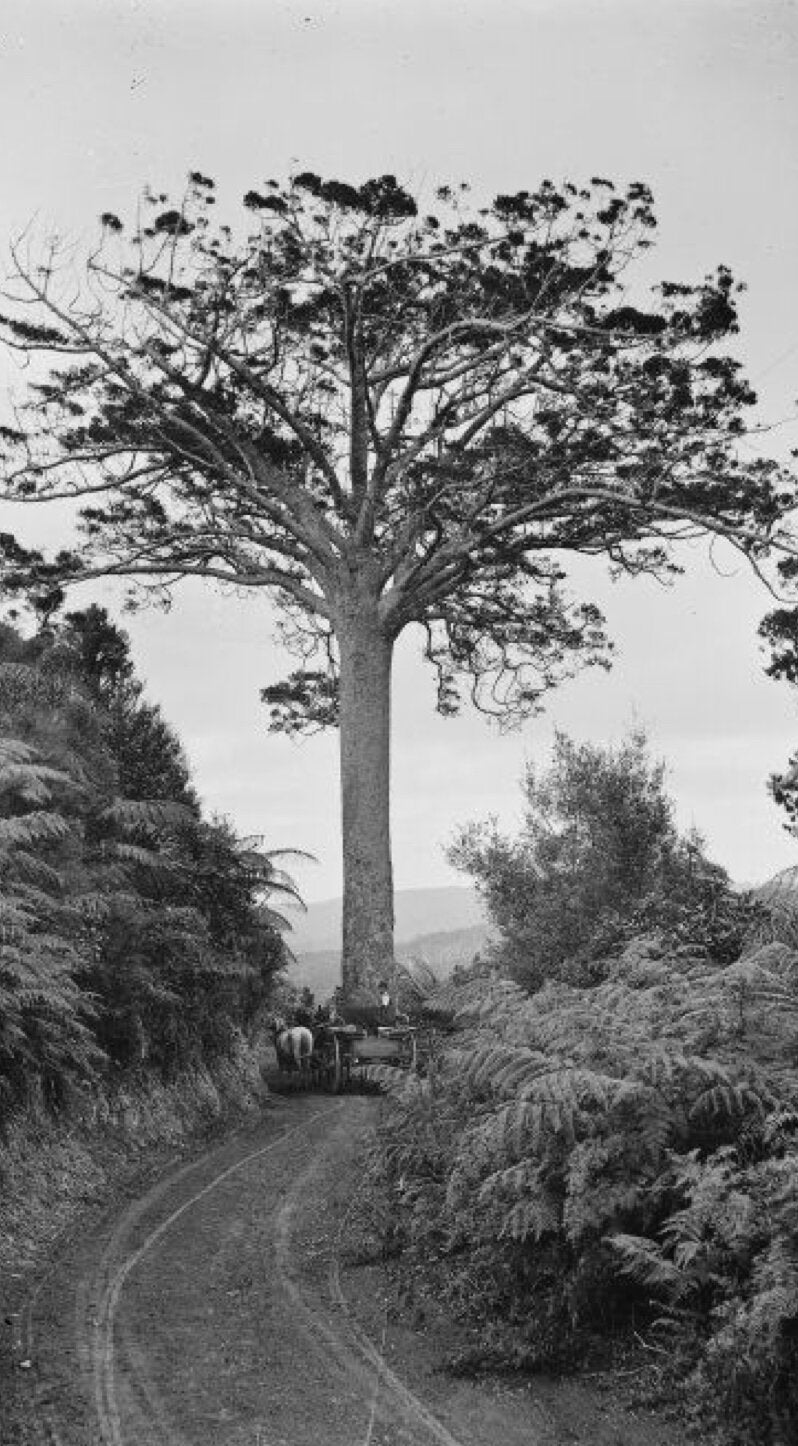
Kauri are the largest trees in New Zealand, reaching heights of up to 50 metres and widths of up to 10 metres. Their timber is straight-grained, durable and buoyant, making it highly valuable.
Māori recognised the importance of kauri long before European arrival. The timber was used for building waka and whare, and for whakairo (carving). Kauri gum was used as a fire starter.
European settlers quickly realised its utility. Pākehā sailors used kauri for ships’ masts and spars, while settlers built strong log houses from the timber.
Logging History on Aotea
The history of kauri use on Aotea is complex. Port Fitzroy was the site of the island’s first kauri timber work in 1794. Nearly a century later, in 1890, a sawmill was established at Bush’s Beach in Kaiaraara Bay.
In 1901, the Kauri Timber Company built the Whangaparapara Mill to process kauri from the mainland. The mill closed in 1914, but logging resumed again in 1926.
Forest stands once considered inaccessible — due to steep slopes and remoteness — were targeted once the dams became operational. This activity eroded valleys and contributed to significant silt deposits at river mouths.
Kauri logging was dangerous, demanding work. The immense size of the logs and the long, physical days made it hazardous. However, the economic rewards were considerable, driven by demand for both timber and gum, which was used as resin and fire starter.
Although the kauri timber industry has long since ended, its legacy highlights how extraordinary Aotearoa’s native plants and trees truly are. They are valued not only for their healing properties, but also for their strength, durability and design.
These species evolved over hundreds of millions of years on an isolated island in subtropical waters — one of the last major landmasses on Earth to be settled by humans.
Kawakawa Balm

The perfect balance between incredible versatility and technical care.
An emollient used to treat irritations of the skin associated with; dry skin, eczema, psoriasis, bites, burns and nappy rash.
Shop Now