


Kā Tiritiri o te Moana
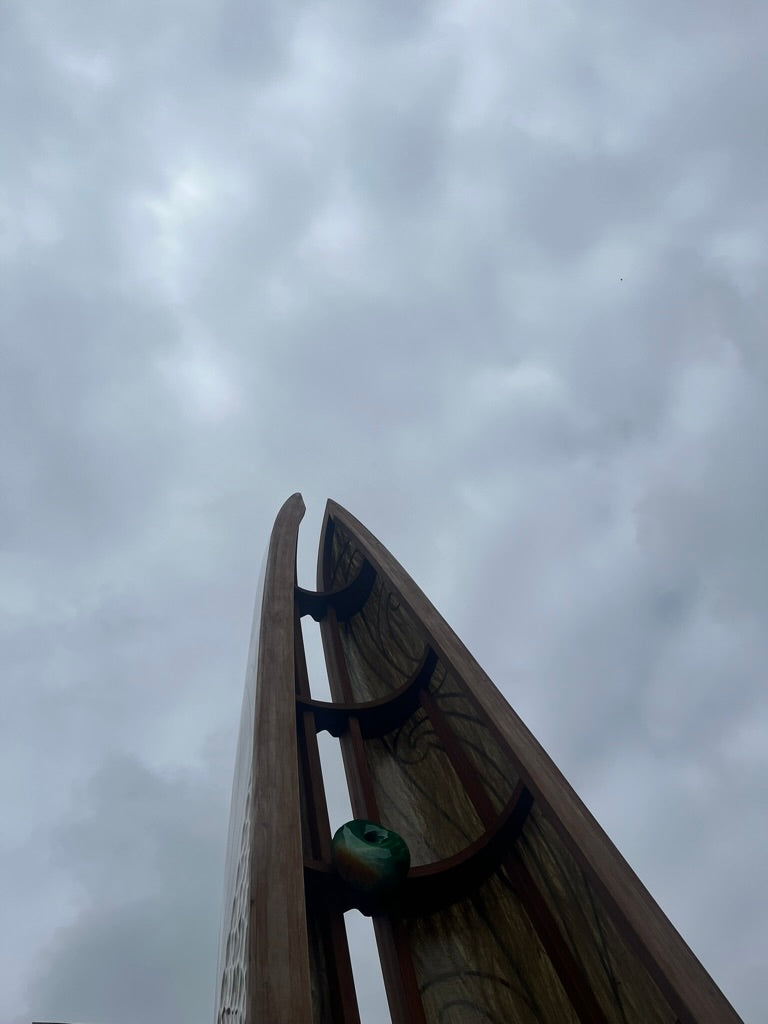
A Ngāi Tahu creation legend tells how Kā Tiritiri o te Moana, the Southern Alps, were formed. Ngāi Tahu is the main Māori iwi of Te Waipounamu, the South Island. They trace their origins back to Tahu Pōtiki, who captained te Takitimu waka after its captain for the voyage from Hawaiki to New Zealand, Tamatea Arikinui, and some of the crew, disembarked on the East Cape, where their descendants became Ngāti Kahungunu and other tribes. Tahu Pōtiki sailed on in Takitimu to Te Waipounamu.
According to the legend, Aoraki and his brothers were the sons of Rakinui. They sailed a grand waka from the heavens to visit the earth, Papatūānuku.
When they had explored the earth’s waters, Aoraki started to chant the karakia that would return them safely in their waka to the Sky Father.
For some reason, possibly a loss of concentration, the spell failed and the waka crashed back to earth. The upturned waka floating on the Southern Pacific Ocean became Te Waipounamu, the South Island of New Zealand.
The brothers climbed onto the hull of the waka, but exposure to the freezing south wind turned them to stone.
Aoraki became the tallest mountain of the Southern Alps. His brothers are the other high peaks, commonly called Mount Tasman, Mount Dampier, Mount Teichelmann and so on.
The Fox Glacier Viewpoint of the Southern Alps is named Te Kopikopiko o Te Waka, meaning “the capsized waka.”
Kā Tiritiri o te Moana means “the Mirage of the Ocean.” The distance from the main spine of the Southern Alps (the Main Divide) to the West Coast ranges from just a few kilometres to about 30 or 50 kilometres.